
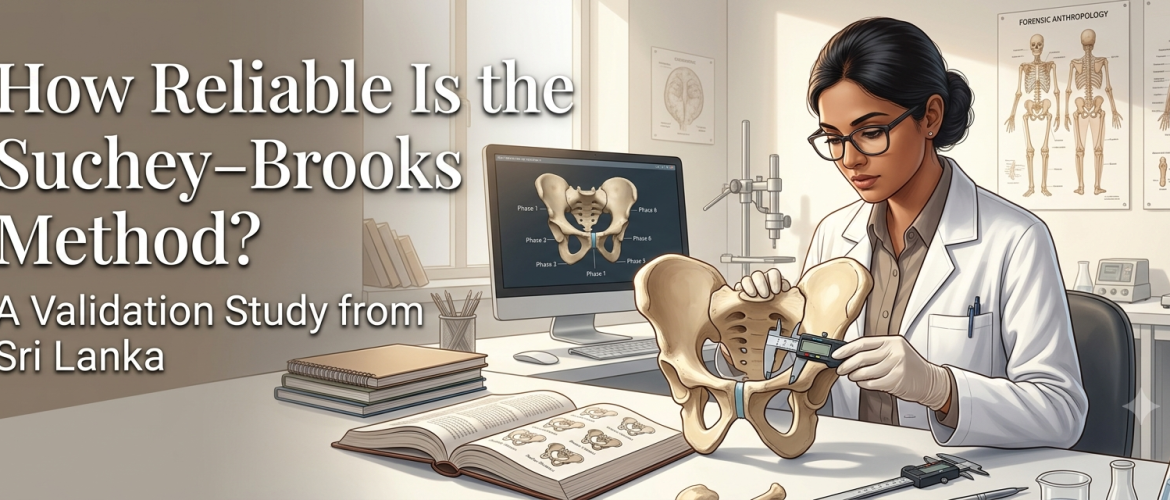
Forensic anthropology plays a vital role in the identification of unknown human remains. Whether investigating criminal cases, mass disasters, or historical burials, one of the primary objectives of a forensic anthropologist is to estimate the biological profile of an individual, including age at death. Accurate age estimation helps narrow the search for missing persons and provides crucial information for medico-legal investigations.
One of the most widely used methods for estimating adult age at death is the Suchey–Brooks method, which examines age-related morphological changes of the pubic symphysis—a joint located at the front of the pelvis. As individuals age, the surface of the pubic symphysis undergoes predictable changes that can be categorized into six developmental phases. Since its introduction, the Suchey–Brooks method has become one of the most accepted standards in forensic anthropology.
However, there is an important consideration. The Suchey–Brooks standards were originally developed using American skeletal collections. Human skeletal ageing is influenced by biological, environmental, nutritional, occupational, and genetic factors, meaning that ageing patterns may differ between populations. Consequently, forensic methods should be scientifically validated before being applied to a different population.
This motivated our recent study, which evaluated the reliability of the Suchey–Brooks method in a contemporary Sri Lankan skeletal population. In addition to assessing its applicability, we investigated whether trained observers could consistently assign the same developmental phases to the pubic symphysis. Observer reliability is essential because a forensic method is only valuable if different practitioners can reproduce the same results.
The findings were encouraging. The study demonstrated excellent intra-observer and inter-observer reliability, indicating that repeated observations by the same observer, as well as assessments by different observers, produced highly consistent results. These findings confirm that the morphological criteria of the Suchey–Brooks method can be applied reliably by trained forensic anthropologists.
Although the method performed well overall, the study also highlighted a common limitation observed in many skeletal age estimation techniques. Accuracy tended to decrease among older individuals because skeletal ageing becomes increasingly variable with advancing age. This reinforces the importance of interpreting age estimates within their confidence intervals and considering complementary age estimation methods when examining older adults.
The study contributes valuable evidence to forensic anthropology in Sri Lanka by demonstrating that the Suchey–Brooks method is a reliable tool for assessing age-related changes of the pubic symphysis. At the same time, it emphasizes the broader need for population-specific validation studies. Establishing locally validated forensic standards enhances the scientific credibility of age estimation and improves the accuracy of biological profile reconstruction in medico-legal investigations.
As forensic anthropology continues to develop in Sri Lanka, research such as this helps build a stronger scientific foundation for the identification of unknown individuals. Ultimately, improving the accuracy and reliability of forensic methods contributes not only to scientific knowledge but also to the pursuit of justice and the humanitarian goal of restoring identity to the deceased.
Read More
Interested in the full research?
Ananda, D. T. H., Varas, C. E. G., Nahallage, C. A. D., Hulathduwa, S. R., & Winburn, A. P. (2026). Reliability of the Suchey–Brooks method for a Sri Lankan contemporary population. Forensic Science International: Reports, 13, Article 100466. https://doi.org/10.1016/j.fsir.2026.100466
Read the full open-access publication here:
https://www.sciencedirect.com/science/article/pii/S2665910726000186